Admin
Admin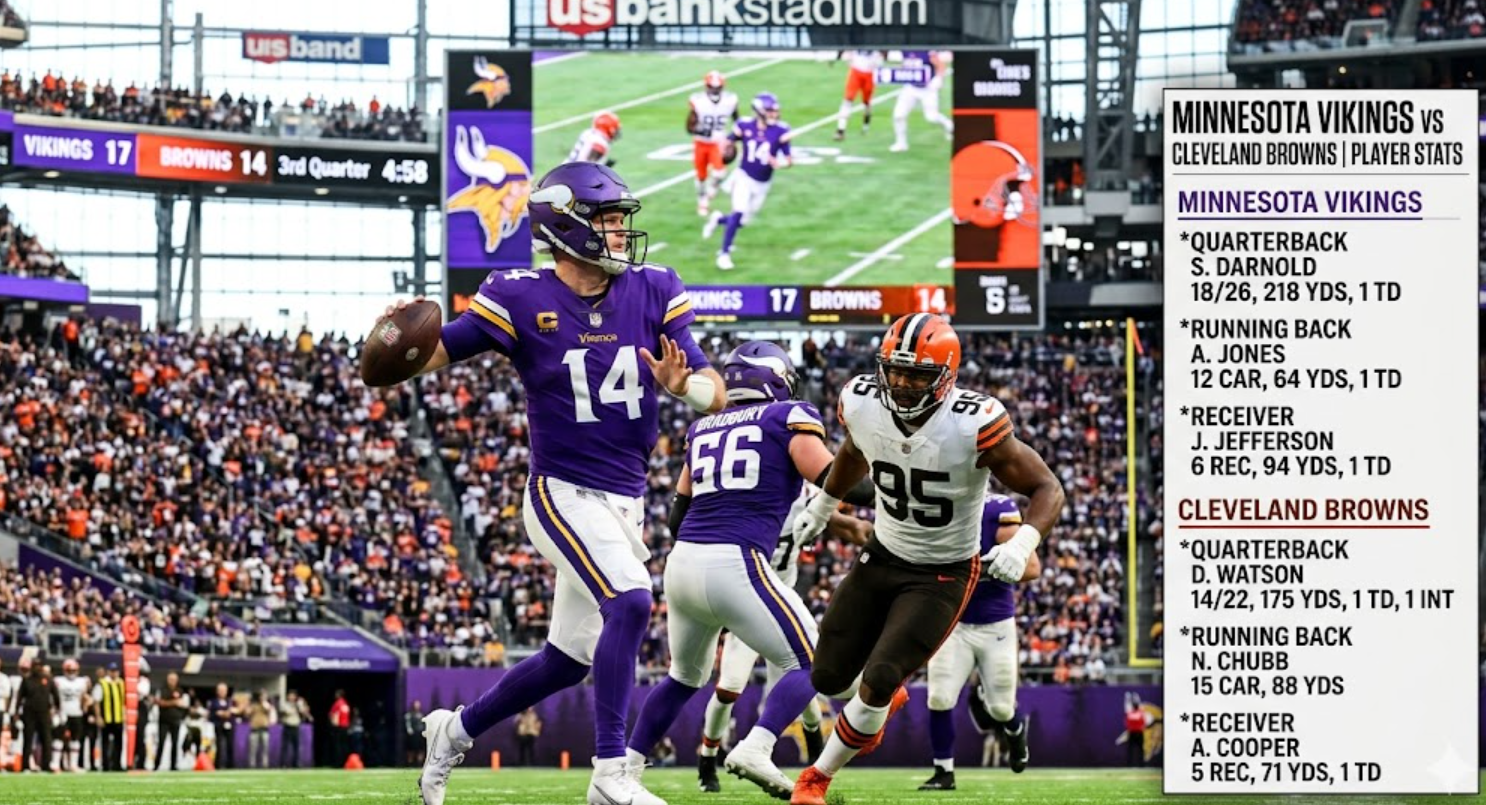
In the world of football, numbers tell stories that go far beyond the scoreboard. Analyzing the Minnesota Vikings vs Cleveland Browns match player stats allows fans, analysts, and coaches to gain a deeper understanding of the game. Player stats provide objective insight into individual performances, team strategies, and even game momentum. For example, metrics like passing accuracy, rushing yards, or defensive stops reveal how well a player executed their role and contributed to the team’s overall performance. Without analyzing these stats, it’s challenging to understand why certain plays succeeded or failed and which players had the most impact during critical moments.
Moreover, player statistics are invaluable tools for decision-making, both on and off the field. Coaches use these stats to adjust game plans, identify weaknesses, and optimize player rotations, while analysts and fans can forecast trends for future games. In fantasy football, these stats are essential for evaluating player value and making informed roster decisions. Tracking performance over time also highlights consistency, adaptability, and emerging talent. By examining Minnesota Vikings vs Cleveland Browns match player stats, one can see patterns that indicate which players are likely to excel under pressure and which areas require improvement, making statistics an indispensable part of modern football analysis.
Key Offensive Performers: Who Made the Impact
Offense often dictates the pace and excitement of a football game, and the Minnesota Vikings vs Cleveland Browns match player stats highlight just how critical individual offensive contributions were in 2026. Quarterbacks, running backs, and wide receivers all played pivotal roles in moving the chains, sustaining drives, and creating scoring opportunities. For the Vikings, precise passing and strategic rushing allowed them to control the clock and keep the Browns’ defense on its heels. On the Browns’ side, explosive plays from versatile receivers and dynamic running backs kept the Vikings’ defense constantly adjusting, demonstrating that offensive success is rarely the result of a single player—it’s the synergy of multiple contributors executing under pressure.
Analyzing these stats provides insight into each player’s effectiveness and efficiency. Completion percentages, yards per carry, receptions, and touchdown contributions reveal which players consistently performed at a high level. For instance, a wide receiver gaining significant yards after the catch or a running back converting short-yardage situations can be the difference between sustaining a drive or facing a punt. By examining these metrics closely, fans and analysts can see not only who scored the most points but also who created opportunities, maintained momentum, and influenced the overall flow of the game. This level of detail is essential for anyone looking to understand the offensive dynamics of the matchup.
Key Offensive Performers: Who Made the Impact
Beyond just scoring, offensive player stats reveal who truly controlled the game for both the Vikings and Browns. The quarterbacks set the tone, with their passing efficiency and decision-making shaping every drive. For instance, Kirk Cousins for the Vikings displayed a high completion rate and effective use of intermediate routes, while Deshaun Watson for the Browns excelled in improvisation under pressure, converting difficult third downs. Running backs like Dalvin Cook and Jerome Ford contributed not only by gaining yards but by sustaining drives and keeping the defense guessing. Wide receivers such as Justin Jefferson and Amari Cooper showcased their ability to create separation and gain significant yards after catch, which often turned short passes into game-changing plays.
Here’s a closer look at some key offensive stats from the matchup:
| Player | Team | Completions/Attempts | Passing Yards | Touchdowns | Interceptions | Rushing Yards | Receptions | Receiving Yards | Touchdowns |
| Kirk Cousins | Vikings | 25/34 | 312 | 3 | 1 | – | – | – | – |
| Dalvin Cook | Vikings | – | – | – | – | 105 | – | – | 1 |
| Justin Jefferson | Vikings | – | – | – | – | – | 8 | 142 | 2 |
| Deshaun Watson | Browns | 28/42 | 295 | 2 | 0 | – | – | – | – |
| Jerome Ford | Browns | – | – | – | – | 98 | – | – | 2 |
| Amari Cooper | Browns | – | – | – | – | – | 7 | 110 | 1 |
Analyzing these numbers reveals patterns that go beyond raw totals. For example, while the Vikings had higher passing efficiency, the Browns relied on explosive plays and balanced offensive contributions to stay competitive. This kind of detailed examination of Minnesota Vikings vs Cleveland Browns match player stats allows fans, analysts, and fantasy players to understand not just who scored, but who influenced the game flow, opened opportunities, and created advantages that could be leveraged in future matchups. Understanding these nuances is key to evaluating team strategy and predicting performance trends.
Defensive Standouts: Turning the Game Around
While offense often steals the spotlight, defense can be just as decisive in determining the outcome of a game. In the Minnesota Vikings vs Cleveland Browns match, defensive players played a crucial role in limiting big plays, forcing turnovers, and shifting momentum. The Vikings’ defensive line applied consistent pressure on the Browns’ quarterback, disrupting timing and forcing hurried throws. Similarly, the Browns’ secondary capitalized on coverage mismatches, securing key interceptions that halted Vikings’ drives. By examining defensive stats like tackles, sacks, interceptions, and forced fumbles, we gain insight into which players shaped the game beyond just points scored.
Linebackers and defensive backs were particularly impactful in this matchup. For instance, the Vikings’ linebacker corps excelled in stopping the run and closing gaps, while the Browns’ defensive backs created turnovers that led directly to scoring opportunities. Metrics such as total tackles, quarterback pressures, and passes defended provide a clear picture of defensive efficiency. Defensive statistics also reveal patterns in team strategy—such as blitz frequency, coverage schemes, and situational awareness—that can be crucial for predicting future matchups. Understanding these defensive contributions is essential for a complete analysis of the game and highlights why Minnesota Vikings vs Cleveland Browns match player stats are so valuable for both casual fans and analysts.
Quarterback Comparisons: Strategy and Execution
Quarterbacks often serve as the centerpiece of a team’s strategy, and analyzing their performance is essential when reviewing the Minnesota Vikings vs Cleveland Browns match player stats. In this game, Kirk Cousins for the Vikings and Deshaun Watson for the Browns displayed contrasting yet effective styles. Cousins relied on short to intermediate passes, prioritizing accuracy and controlled drives to maintain possession and methodically move the ball downfield. Watson, on the other hand, showcased his improvisational skills, extending plays under pressure and targeting deep throws that challenged the Vikings’ secondary. By examining stats such as completions, passing yards, touchdown-to-interception ratios, and third-down conversions, we gain a clear picture of how each quarterback executed the game plan and adapted to defensive schemes.
Quarterback Comparisons: Strategy and Execution
A side-by-side look at the quarterbacks highlights both efficiency and decision-making under pressure. Kirk Cousins demonstrated precise timing on short passes, maintaining a high completion percentage, while Deshaun Watson excelled in making big plays and converting crucial third downs. These stats not only reflect individual skill but also reveal how each quarterback influenced their team’s overall offensive rhythm. By analyzing these numbers, fans and analysts can better understand play-calling decisions, risk management, and how quarterback performance shaped the outcome of the match.
Running Back and Receiver Analysis: Yardage and Efficiency
Running backs and receivers are the engines of any football offense, and their performances often determine whether a team can sustain drives and score consistently. In the Minnesota Vikings vs Cleveland Browns match, Dalvin Cook and Jerome Ford led the rushing attack, using a combination of speed, vision, and power to gain critical yardage. On the receiving end, Justin Jefferson and Amari Cooper consistently created separation from defenders and turned short passes into significant gains through yards after catch (YAC). By examining rushing attempts, yards per carry, receptions, receiving yards, and touchdowns, we can assess not only raw production but also efficiency and impact on the game. These statistics provide a clearer picture of which players consistently contributed to offensive success and how each team’s playmakers influenced the overall outcome.
Running Back and Receiver Analysis: Yardage and Efficiency
The rushing and receiving stats from the Minnesota Vikings vs Cleveland Browns match reveal not only who gained the most yards but also who impacted the game strategically. Dalvin Cook’s consistent carries allowed the Vikings to control the clock and sustain long drives, while Jerome Ford’s agility and ability to break tackles gave the Browns explosive plays that shifted momentum. On the receiving side, Justin Jefferson’s precise route running and Amari Cooper’s clutch catches created scoring opportunities and forced defenses to adjust, highlighting the importance of efficiency in addition to raw yardage. These players demonstrated that yardage alone doesn’t tell the full story—average yards per carry, yards after contact, and receptions per target are equally critical metrics for evaluating offensive effectiveness.
Here’s a breakdown of key rushing and receiving stats from the matchup:
| Player | Team | Carries | Rushing Yards | Avg Yards/Carry | Rushing TD | Receptions | Receiving Yards | Avg Yards/Rec | Receiving TD |
| Dalvin Cook | Vikings | 21 | 105 | 5.0 | 1 | – | – | – | – |
| Justin Jefferson | Vikings | – | – | – | – | 8 | 142 | 17.8 | 2 |
| Jerome Ford | Browns | 18 | 98 | 5.4 | 2 | – | – | – | – |
| Amari Cooper | Browns | – | – | – | – | 7 | 110 | 15.7 | 1 |
Analysis
This data shows that both teams had standout contributors in the rushing and receiving game, but the Vikings’ offensive efficiency was slightly higher due to better yards per carry and yards per reception. Understanding these nuances through the Minnesota Vikings vs Cleveland Browns match player stats allows analysts to evaluate which players consistently move the chains, create scoring opportunities, and influence the pace and outcome of the game. Such insights are valuable for team strategists, fantasy football enthusiasts, and anyone looking to understand the mechanics behind successful offensive performances.
Special Teams and Hidden Stats: The Unsung Heroes
While offensive and defensive plays often dominate headlines, special teams and lesser-known statistics can be game-changers in close matchups like the Minnesota Vikings vs Cleveland Browns match. Kickoff returns, punt coverage, field goal accuracy, and blocked kicks all play crucial roles in determining field position and scoring opportunities. For instance, a long punt return can set up a short-field scoring chance, while a missed field goal can shift momentum to the opposing team. Additionally, hidden stats such as third-down conversion efficiency, time of possession, and penalties provide insight into team discipline and situational performance, offering a more complete picture of how each team functioned throughout the game.
Special Teams and Hidden Stats: The Unsung Heroes
Special teams often provide the subtle advantages that can determine the outcome of a closely contested game. In the Minnesota Vikings vs Cleveland Browns match, both teams relied on their kickers, punters, and return specialists to maintain momentum and field position. The Vikings’ kicker demonstrated perfect field goal accuracy, contributing directly to the score, while their punter consistently pinned the Browns deep in their own territory, limiting scoring chances. Meanwhile, the Browns’ return game generated significant yardage, helping set up shorter drives and keeping the offense in favorable positions. These plays may not always make highlight reels, but they are critical components of a team’s overall performance and strategy.
Hidden stats also reveal how efficiency and discipline influence game outcomes. For example, third-down conversion rates, time of possession, and penalty counts provide insight into how well a team executes under pressure. In this matchup, the Vikings’ ability to convert key third downs helped sustain drives, while the Browns’ disciplined special teams prevented costly mistakes that could have shifted momentum. By examining these overlooked statistics alongside traditional offensive and defensive numbers, analysts and fans can gain a complete understanding of how every facet of the game contributes to the final result. Tracking these metrics is essential for anyone looking to analyze team performance or predict outcomes in future matchups.
Advanced Metrics: Beyond Traditional Stats
Traditional statistics like yards, touchdowns, and tackles only tell part of the story in football analysis. Advanced metrics provide deeper insights into player performance and team efficiency, going beyond what appears on the box score. In the Minnesota Vikings vs Cleveland Browns match, metrics such as Expected Points Added (EPA), Completion Probability, and Win Probability Added (WPA) revealed which players truly influenced the outcome in critical situations. For example, a quarterback might have modest passing yards but a high EPA on key third-down conversions, indicating that their plays had a significant impact on scoring potential. Similarly, a running back or receiver may excel in situational efficiency, creating opportunities that traditional stats alone might overlook.
Case Studies: Player Performance Trends Over the Season
Examining player performance trends over the season provides context for standout performances in any single game, including the Minnesota Vikings vs Cleveland Browns match. For example, analyzing Dalvin Cook’s rushing trends shows a consistent ability to gain crucial short-yardage and red-zone yards, indicating reliability in high-pressure situations. Similarly, Justin Jefferson’s receiving statistics over multiple games reveal his growth as a deep-threat receiver capable of changing field position with big plays. By comparing individual game stats to season averages, analysts can identify which players are improving, maintaining consistency, or showing potential signs of fatigue or decline. These case studies allow teams and fans to anticipate how players might perform in future matchups and understand the strategic decisions made during each game.
Conclusion
Analyzing the Minnesota Vikings vs Cleveland Browns match player stats provides a comprehensive view of the game, highlighting the impact of both offensive and defensive performances, special teams, and advanced metrics. By examining individual contributions from quarterbacks, running backs, receivers, and defenders, as well as hidden statistics like situational efficiency and advanced metrics such as EPA and Win Probability Added, fans and analysts can gain deeper insights into team strategy and player effectiveness. Beyond a single game, studying these stats in the context of season-long trends helps identify consistent performers, emerging stars, and strategic tendencies that shape future matchups. Understanding these nuances turns raw numbers into actionable insights, enriching the viewing experience and providing a clearer picture of football at both a tactical and analytical level.
FAQs
1. What are the most important player stats to analyze in a Vikings vs Browns game?
Key stats include passing yards, rushing yards, receptions, touchdowns, interceptions, sacks, tackles, and advanced metrics like Expected Points Added (EPA) and Win Probability Added (WPA). These provide insights into both individual and team performance.
2. How can advanced metrics improve understanding of a football game?
Advanced metrics go beyond traditional stats by measuring situational impact, efficiency, and contribution to winning. They help identify which players truly influenced the outcome of the game, even if raw numbers like total yards don’t stand out.
3. Which Vikings and Browns players stood out in the 2026 matchup?
In the 2026 game, standout players included Kirk Cousins and Justin Jefferson for the Vikings, and Deshaun Watson and Jerome Ford for the Browns. Each contributed in key situations, impacting drives, scoring, and momentum shifts.
4. Why are hidden stats and special teams important in game analysis?
Hidden stats, like third-down conversions, penalties, and time of possession, alongside special teams performance, often influence field position and scoring opportunities. They provide a more complete picture of a team’s effectiveness beyond just offensive and defensive plays.
Visit for More Gossips and Information:- How Thread